
 By ABDULLAH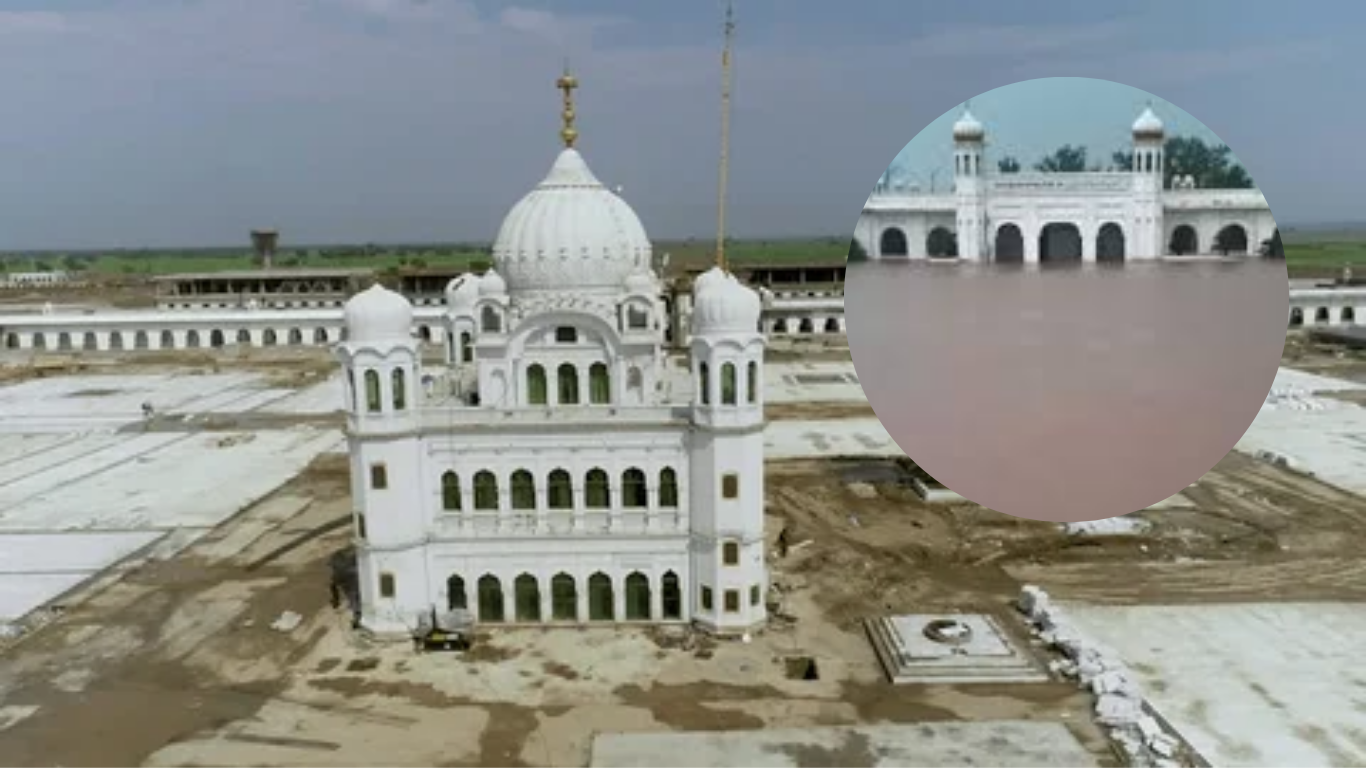
The sacred Sikh shrine Gurdwara Darbar Kartarpur Sahib in Pakistan’s Narowal district has been partially submerged after heavy monsoon floods from the Ravi River swept into its marble courtyards. The flooding has forced the closure of the Kartarpur Corridor, halting pilgrimages and leaving devotees on both sides of the border anxious.
Visuals from Narowal show the white marble complex of Kartarpur Sahib Gurdwara standing in three to four feet of water. The rising river, fueled by record monsoon rains, glacial melt, and releases from Indian dams, inundated the shrine’s courtyard and lower chambers overnight.
Officials confirmed that the sacred Saroop of Guru Granth Sahib Ji was moved to safety on the first floor, while sevadars (volunteers) continue to guard the site. “The main structure remains safe because it is on an elevated platform,” an official of the Evacuee Trust Property Board (ETPB) told reporters, “but the lower areas are under water, and pilgrimage has been suspended until further notice.”
Around 200–300 pilgrims were stranded in the Kartarpur Corridor when the floods hit. Rescue operations, led by the Pakistan Army and Punjab Disaster Management Authority, helped move visitors to safer ground.
Across the border in Gurdaspur district of Indian Punjab, the historic town of Dera Baba Nanak home to another sacred Sikh site also faces danger as the Ravi swells with continuous rainfall from Himachal Pradesh and IIOJK (Indian Illegally Occupied Jammu and Kashmir).
The Kartarpur Corridor, opened in November 2019, was hailed as a milestone in Pakistan–India relations. It allows visa-free access for Indian pilgrims to visit the shrine where Baba Guru Nanak, the founder of Sikhism, spent his final days. For Sikhs worldwide, Kartarpur is among the holiest pilgrimage destinations, second only to Sri Harmandir Sahib (Golden Temple) in Amritsar.
The closure of the corridor due to floods is a painful moment for many Sikhs. “For us, Kartarpur is like Mecca or Vatican City,” said Balwinder Singh, a devotee who was scheduled to visit from Amritsar. “Seeing water swallow its steps is heartbreaking.”
Punjab is experiencing its worst flooding in more than a decade. According to WAPDA (Water and Power Development Authority):
- Indus River at Tarbela: inflow 240,000 cusecs, outflow 245,400 cusecs.
- Jhelum River at Mangla: inflow 34,000 cusecs, outflow 8,000 cusecs.
- Chenab at Head Marala: inflow 107,500 cusecs, outflow 89,500 cusecs.
- Ravi at Jassar: over 200,000 cusecs flowing downstream toward Shahdara, Lahore.
Authorities have evacuated nearly 190,000 people from low-lying villages, with livestock and crops destroyed. Families displaced by the floods have been moved to temporary shelters.
On the Indian side, Punjab officials warned of rising waters threatening farmlands and historic towns. Emergency control rooms have been set up in Gurdaspur and Amritsar to monitor the situation.
Experts point to a combination of factors:
- Record-breaking monsoon rains across Punjab.
- Glacial melt from the Himalayas due to rising temperatures.
- Sudden water releases from Indian dams, which have increased the burden on downstream rivers.
This triple impact has overwhelmed flood defenses in both countries.
Images of Kartarpur Sahib submerged in water have gone viral on X (formerly Twitter) and Facebook, sparking emotional reactions.
“Seeing Guru Nanak’s resting place under water is a wound to our faith,” wrote one Sikh devotee.
“Authorities must work together across borders. Faith and humanity should rise above politics in times of crisis,” tweeted another.
- Religious Tourism Loss: Closure of the Kartarpur Corridor will affect thousands of pilgrims and local businesses dependent on religious tourism.
- Diplomatic Tensions: Water management has always been sensitive between India and Pakistan under the Indus Waters Treaty (1960). Flooding could trigger fresh debates over dam releases.
- Cultural Damage: Even though the central shrine is safe, repeated submergence could harm its foundations and heritage.
- Humanitarian Crisis: Thousands remain displaced, with food and shelter shortages reported in Narowal and Lahore districts.
Q1: Is the Kartarpur Sahib Gurdwara damaged?
No major damage has been reported. The elevated central shrine is safe, but the lower courtyards and marble steps are under water.
Q2: Can Sikh pilgrims still visit Kartarpur Sahib?
Currently, no. The Kartarpur Corridor is closed due to flooding, and all pilgrimage activities are suspended.
Q3: How many people have been evacuated due to Punjab floods?
Nearly 190,000 people have been evacuated in Pakistan, while thousands more in India remain on alert.
Q4: Has this kind of flooding happened before?
Yes, Punjab has faced devastating floods in 2010 and 2014, but experts say 2025 floods are among the worst in a decade.
Q5: What measures are being taken by authorities?
Both Pakistan and India have deployed disaster response teams, evacuated villages, and set up relief camps. However, continuous rainfall keeps the threat alive.
The flooding of Kartarpur Sahib is more than a natural disaster it’s a moment of grief for millions of Sikhs worldwide. As Pakistan and India battle rising waters, cooperation in river management and climate resilience is urgently needed. Protecting sacred sites and vulnerable communities should rise above politics, reminding us that nature recognizes no borders.