
 By ABDULLAH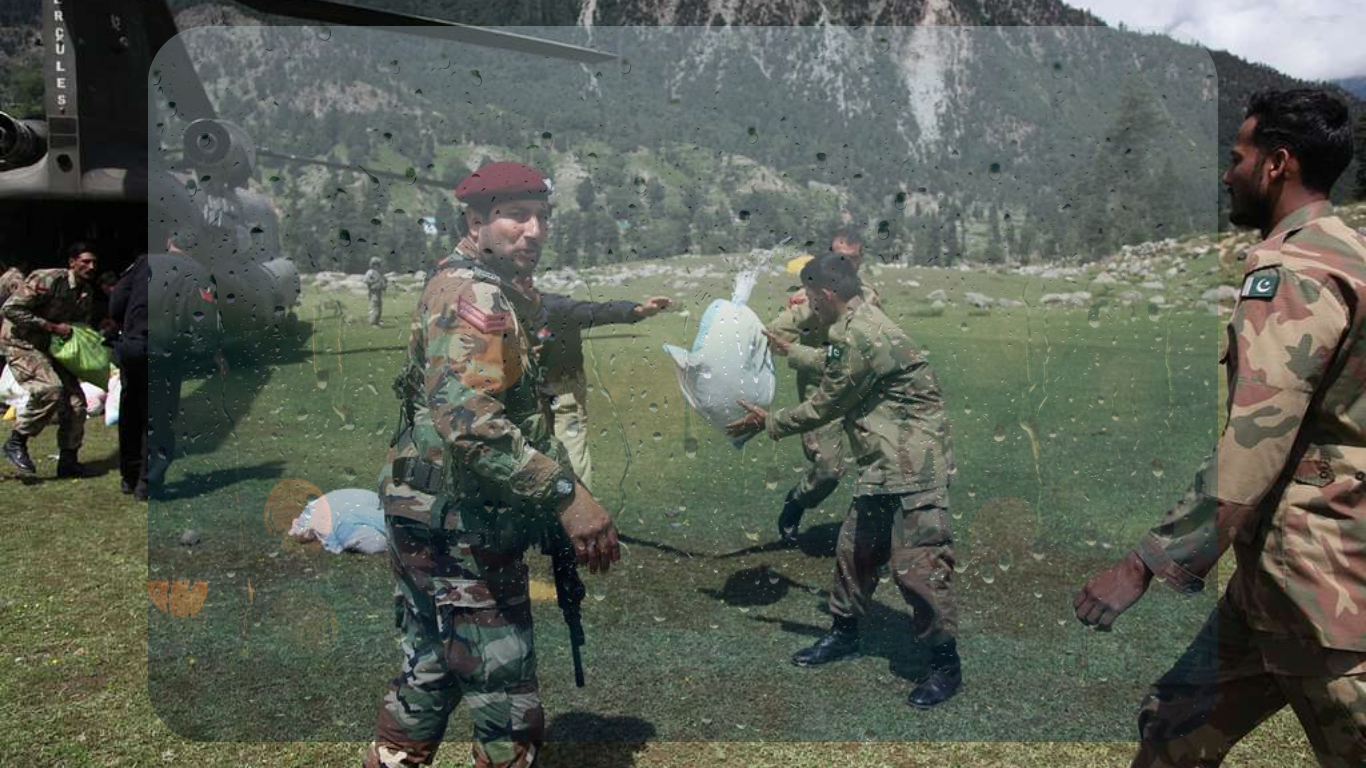
Severe flooding has forced the Punjab government to request the immediate deployment of the Pakistan Army in six districts as rising river levels and continuous rainfall push the province into crisis.
The affected districts — Lahore, Kasur, Sialkot, Faisalabad, Narowal, and Okara — have reported widespread inundation following heavy monsoon rains and the release of excess water from Indian dams. The Provincial Disaster Management Authority (PDMA) has issued a red alert, warning of a “very high to exceptionally high” flood risk over the next 48 hours.
According to the Punjab Home Department, local administrations had already mobilized Rescue 1122, Civil Defence, and police teams. However, the scale of the disaster has prompted an urgent call for military assistance.
The Pakistan Army will support:
- Emergency evacuations in flood-hit villages
- Reinforcement of river embankments
- Logistics and supply chain operations for stranded communities
- Possible army aviation support for inaccessible areas
Authorities confirmed that the number of troops in each district will be decided in consultation with local administrations.
Floodwaters have surged to alarming levels in major rivers:
- Chenab River (Head Marala): Inflows exceed 900,000 cusecs, matching the 2014 record floods.
- Sutlej River (Ganda Singh Wala): Flow recorded at 245,236 cusecs, expected to rise further.
- Ravi River (Kot Nainan/Jassar): Over 225,000 cusecs discharged, submerging agricultural and residential land.
Deputy Commissioner Sialkot confirmed that the district has received 405 mm of rainfall, the heaviest in more than a decade. Schools have been closed, Section 144 imposed, and thousands of residents evacuated to relief camps.
Federal Minister for Planning, Ahsan Iqbal, confirmed Narowal as one of the worst-hit areas, noting that overflow from the Dek Nullah has worsened the situation. He urged citizens to remain cautious and avoid unnecessary travel.
Prime Minister Shehbaz Sharif has directed provincial authorities to accelerate rescue operations, provide food, shelter, and medical aid, and ensure safety in affected areas.
The NDMA (National Disaster Management Authority) has also warned that Pakistan’s glacial melt and extreme monsoon patterns, driven by climate change, will likely increase the frequency of such disasters in the coming years.
NDMA Chairman Lt Gen Inam Haider Malik told parliament that nearly half of Pakistan’s 7,500 glaciers are melting at an accelerated pace, threatening water resources and increasing disaster vulnerability. He noted that Pakistan suffers $4 billion in flood-related damages annually.
“The next 48 hours are critical for Punjab,” said Irfan Ali Kathia of the PDMA. “Our focus is on saving lives and limiting property damage, but the scale of the floods demands both local and international support.”
Authorities have urged citizens to:
- Stay indoors and avoid unnecessary travel
- Keep away from rivers, nullahs, and low-lying areas
- Follow official updates via TV, radio, mobile alerts, and the NDMA app
- Cooperate with evacuation teams and relief workers
The Punjab flood crisis highlights both the immediate need for strong disaster response and the long-term urgency of climate resilience. With rising rivers and overflowing dams, Pakistan’s vulnerability to extreme weather is again in the spotlight — a challenge the country cannot face alone.