
 By ABDULLAH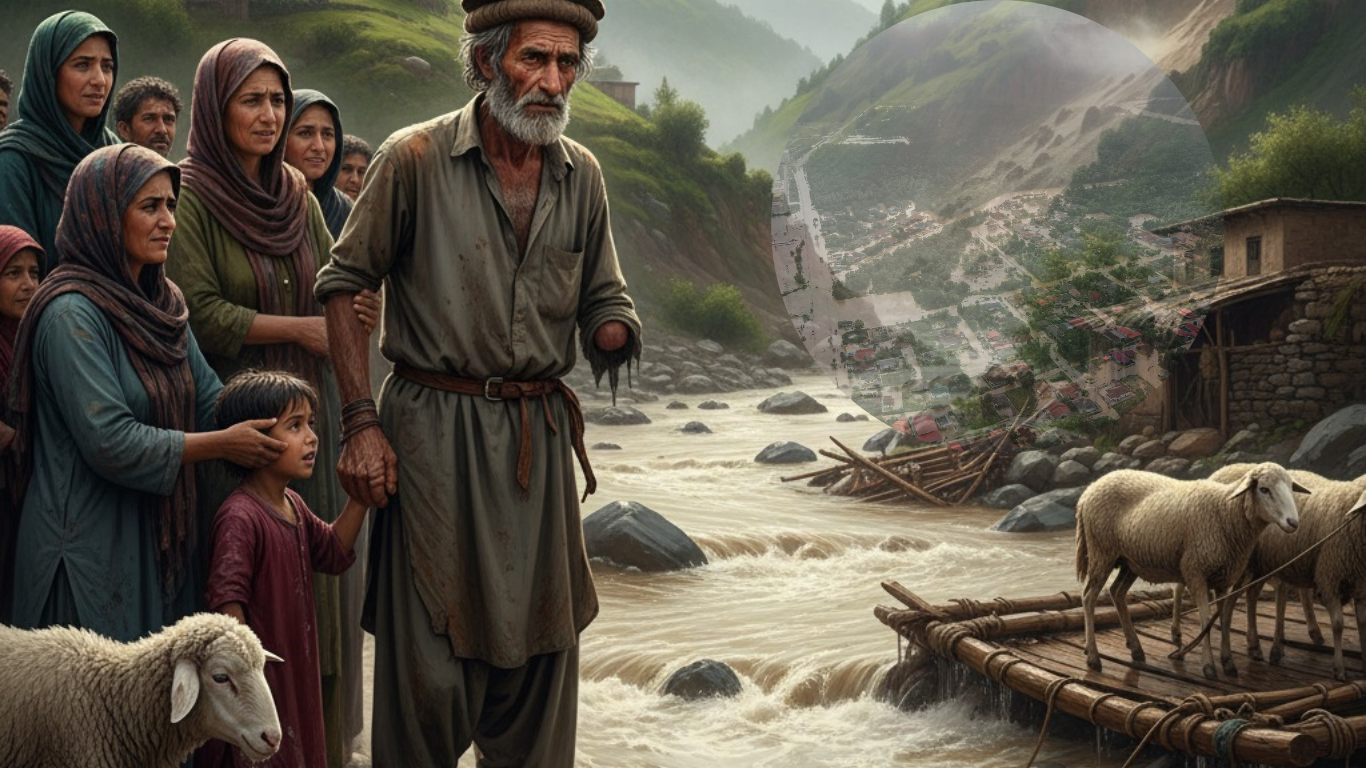
The recent floods in Khyber Pakhtunkhwa (KP) have left a trail of destruction, displacing thousands of families, destroying infrastructure, and claiming hundreds of lives. But within this tragedy, stories of bravery and resilience have emerged that reflect the strength of ordinary Pakistanis. From a shepherd in Shangla who lost his hand while saving his neighbors, to a father in Buner rebuilding his home with bare hands, and a federal minister walking miles through wrecked terrain to reach survivors these are reminders that even in disaster, humanity stands tall.
On the night of August 14–15, in the Drad area of Puran tehsil, 57-year-old shepherd Sher Malik heard desperate cries for help. His neighbors, a family without any male members at home, were trapped in their house surrounded by raging floodwaters.
“My house is on higher ground. I knew if I didn’t act, they would be swept away,” Malik recalled.
Without hesitation, he rescued the children first, then the women. But when the family begged him to save their cattle — their only livelihood — Malik risked his life again. While saving a goat, the house’s roof collapsed on him.
The sharp steel sheets crushed his hand, trapping him for three hours in fast-flowing water. Though severely injured, he eventually freed himself. Later, he lost his hand to the injuries — a heavy price for his bravery.
“As a Muslim, a human and a neighbor, it was my duty,” he said. “If I hadn’t gone, they would have died like many others.”
Local residents now support him with food and treatment, but they also urge the government to provide him long-term assistance.
In Buner’s Pir Baba area, another story unfolded. Hussain Ali, a 48-year-old father of four, lost his modest home to flash floods on August 15. With no machinery, no cement, and no financial aid yet, Hussain decided to rebuild his house stone by stone.
“I have no money. But I have strong hands. My children need a roof before the winter,” he said.
Each day, he collects broken bricks and wood from nearby areas, stacking them under a plastic sheet that serves as his temporary shelter. His determination has inspired neighbors to help in small ways — sharing food, lifting stones, or simply offering encouragement.
Local organizer Mohammad Farooq described Hussain’s resolve as “a quiet inspiration in the face of despair,” while also urging philanthropists to accelerate aid.
In another rare scene, Federal Minister Engineer Amir Muqam traveled on foot through Shangla’s landslide-hit terrain to meet flood victims cut off by washed-out bridges and blocked roads.
“We thought we were alone,” said 70-year-old Hamza Khan. “But today, our minister crossed rivers and mountains just to reach us. This gave us hope.”
Unlike traditional visits filled with speeches, Muqam sat with victims, listened to their concerns, and assured immediate action. He appealed to international NGOs for urgent aid to rebuild destroyed infrastructure, homes, and livelihoods.
According to the Provincial Disaster Management Authority (PDMA):
- 410 deaths and 247 injuries confirmed in KP.
- 332 families of deceased compensated with Rs 2 million each.
- Over 2,800 shops, 326 schools, 106 bridges, and 526 link roads damaged.
- Rs 5 billion released for relief and rehabilitation efforts.
Despite these steps, survivors like Sher Malik and Hussain Ali highlight the gaps between official aid and ground realities.
Social media users have praised these acts of bravery. Many called Sher Malik a “true hero of Pakistan,” while Hussain’s resilience trended under hashtags like #PakistanFloods2025 and #RebuildTogether.
Local residents expressed frustration over slow aid delivery but also shared gratitude for the courage shown by fellow citizens and officials who stood with them.
Natural disasters often reduce people to statistics — numbers of dead, injured, or displaced. But human stories like Malik’s sacrifice, Hussain’s persistence, and Muqam’s solidarity remind us that resilience is as real as destruction.
These acts also highlight the need for:
- Faster relief delivery in remote areas.
- Financial compensation for individuals who risk or lose their livelihoods during rescues.
- Long-term rehabilitation programs focusing on housing, health, and agriculture.
Q1: Which areas were worst affected by the recent floods?
Shangla, Buner, and other parts of Malakand division in KP were severely affected, with homes, roads, and farmland destroyed.
Q2: How many people have been displaced?
Tens of thousands across KP, with many still living in temporary shelters or tents.
Q3: What support is the government providing?
Compensation for deceased and injured families, funding for reconstruction, and relief camps. However, delays due to damaged infrastructure remain a challenge.
Q4: How are locals coping?
Many rely on community solidarity. Stories like Sher Malik’s and Hussain’s show how individuals are stepping up where official aid has been slow.
Q5: How can I help?
Donations to NGOs working in flood-affected areas, providing essentials like tents, food, mosquito nets, and medical aid, can make a direct impact.
The floods of 2025 have brought immense suffering to Khyber Pakhtunkhwa, but they have also unveiled stories of extraordinary courage. From Sher Malik’s heroic sacrifice in Shangla to Hussain’s determination in Buner and Amir Muqam’s symbolic solidarity, these stories highlight the resilience of Pakistanis in the face of crisis.
In a land battered by natural disasters, it is this human spirit that keeps hope alive proving that even after devastation, life can and will be rebuilt.